Willingness to pay
On holiday, nice weather, route planned, legs willing. All I needed was a bike. There are two rental bike shops and only one is open. Easy.
And the price? Fifty euros for the day. Shit, I had mentally budgeted 25. 35 at most. 40 assuming the "holiday splurge" and "daylight robbery"...
I didn't need a complete day, just 2 or 3 hours. I tried to negotiate. Maybe I could rent half a day... Impossible, I am negotiating in a non-competition market.
What should I do... Maybe I will find an alternative walking route... Fifty euros, really?
I thanked the rental man politely, declined, and walked away on foot — leaving behind the bike, the route, and quite possibly a once-in-a-lifetime view.
Later that evening, drinking a reasonably priced drink and reflecting on my newfound free time, I realized something: I still had some (few) euros in my pocket, but no awesome landscape in my memory. It wasn’t about the money — it was about the principle...
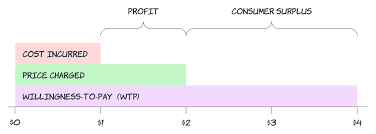
According to behaviorial economics, this is a textbook case or reference pricing clashing with willingness to pay. My inner economist knew I could afford it. But my inner philosopher refused to reward what felt like a princing sin.
Fairness as a Constraint on Profit Seeking
Far from being a personal quirk, my refusal to rent the overpriced bike fits neatly into the framework outlined by Daniel Kahneman and Richard Thaler, two giants of behavioral economics who spent decades proving that humans are not the rational calculators economists once imagined. In their work "Fairness as a Constraint on Profit Seeking" (1986), they demonstrate how consumers often reject deals not because they lack the resources or the need, but because the transaction feels morally wrong. In other words: even if the product is desirable and affordable, if the price violates our internal sense of fairness, we will gladly sabotage our comfort to punish what we perceive as greedy or exploitative behavior.
They also introduced the concept of loss aversion — the idea that losses feel more painful than equivalent gains feel good. The emotional loss of overpaying is simply too bitter.
Uhmm... naa!
Loss Aversion: Helpful Instinct or Saboteur of Joy?
Kahneman and Tversky tell us that we tend to fear losses twice as much as we enjoy equivalent gains. It's a useful evolutionary trait — if you are a hunter-gatherer, losing food or shelter is far worse than gaining a little extra.
But in today's world? That same instinct can become emotionally expensive.
What would a calm, rational, self-confident person do?
Maybe the key is to evaluate the moment, not just the money:
"I can afford this. I value the experience. I choose joy today
— not because it's cheap, but because it's meaningful."
Learning to identify when our brain is guarding us from real danger, and when it's just playing accountant at the cost of joy, is a lifelong skill.
I didn't rent the bike. That's okay. Next time, maybe I will.